
The grocers U.S. shoppers are most devoted to right now, Trader Joe’s, Aldi, and Costco, share a pattern. They carry tight, private-label-heavy assortments, keep pricing simple, and give shoppers reasons to visit that have nothing to do with points or coupons. Satisfaction scores, market share, and membership renewals all show the gap widening, and regional grocers can borrow more of that playbook than they might expect.
Why would anyone plan a Wednesday around a tote bag?
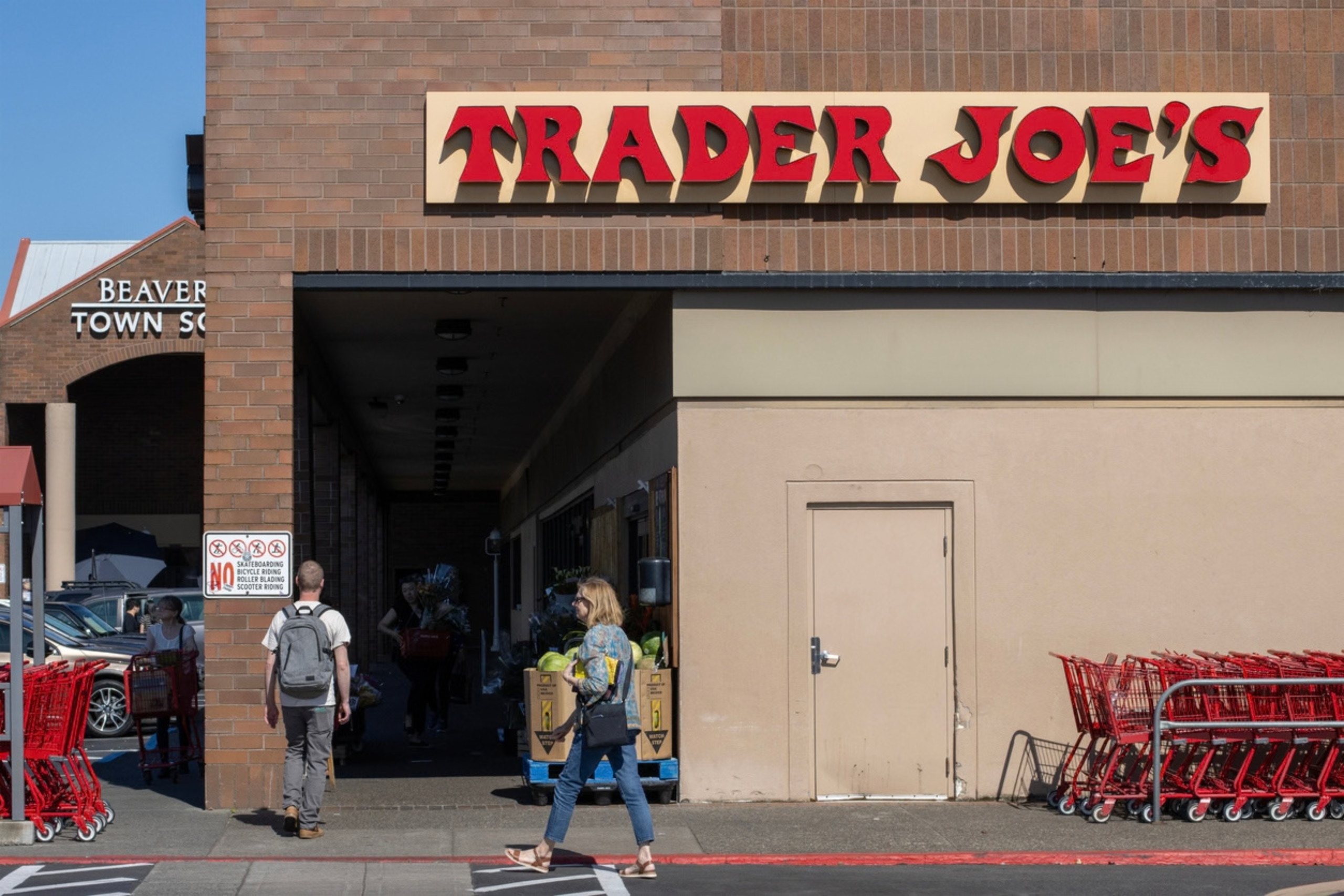
Your loyalty program may have millions of members, and very few of them would plan a Wednesday around your store. On June 17, Trader Joe’s released a pastel, striped mini version of its canvas tote, and visits that day ran 43.7 percent above its usual Wednesday. The lift carried into Thursday and Friday.
That kind of response is rare in grocery, and it is concentrated in a handful of chains. Trader Joe’s, Aldi, and Costco have built something closer to a fan base than a customer base, and the past year of data shows their lead growing while the rest of the industry holds roughly flat.
Three signals the gap is growing
The first signal is satisfaction. The 2026 American Customer Satisfaction Index ranked Trader Joe’s first among supermarkets with a score of 86, up 2 percent, while the industry average slipped 1 percent to 78. Aldi and Costco each scored 81, and Trader Joe’s was one of only three supermarkets to improve at all.
The second is market share. According to Numerator, discounters such as Aldi and specialty chains such as Trader Joe’s gained share in the twelve months ending June 30, 2026, while Kroger, Albertsons, and Ahold Delhaize USA lost it.
The third is membership, and Costco makes it the most measurable, because shoppers pay for it. Costco reported a 92.3 percent renewal rate in the U.S. and Canada for its fiscal fourth quarter. It said its base of members under 40 has grown nearly 60 percent since the pandemic and now makes up more than a quarter of all members, even as overall membership growth has slowed.
What do the cult grocers have in common?
All three run assortments far smaller than a conventional supermarket and lean heavily on their own brands. That gives shoppers products they cannot find anywhere else, and a product you can only get in one place is what turns a favorite item into a reason to visit.
They also give shoppers a reason to come back this week. Trader Joe’s says that when an item does not pull its weight, it goes away to make room for something new, so the shelf is always changing. The tote bag data shows what that rotation does to traffic: scarcity turns an ordinary grocery run into an event people talk about.
Their pricing is simple enough to trust. Trader Joe’s states plainly that it does not run sales, offer coupons, or operate a loyalty program, because it wants every customer to get its best price every day. At a time when shoppers and lawmakers are questioning personalized pricing, one price for everyone reads as a signal of fairness.
Finally, their fans do much of the marketing. Independent fan accounts on Instagram share Trader Joe’s finds with large followings, and the company pays nothing for that reach.
Fandom still runs on value
Loyalty at these chains still rests on value, though not always on the lowest price. dunnhumby’s 2025 Retailer Preference Index classified Trader Joe’s as a quality-first retailer, well ahead of the market on quality and about average on savings, while Aldi competes on the price of the weekly basket. The 2026 edition found shoppers even more focused on savings as essential costs rise.
Both models work because shoppers believe the value is fair before any of the fun starts. A limited-edition tote bag at a store with inflated prices would read as a gimmick.
What can a regional grocer borrow?
Regional chains are not locked out of this. In dunnhumby’s 2026 index, H-E-B, Market Basket, and Woodman’s took the top three spots, the first time all three leaders were regional chains, ahead of Costco, Aldi, and Trader Joe’s. Publix and H-E-B also outscored Aldi and Costco in the ACSI ranking, which shows that a regional grocer can earn the same kind of devotion.
Start with the products only you sell. A private label with a point of view, a signature prepared item, or a local product the discounter does not carry gives fans something to talk about, the way Publix’s Pub Sub has become the regional equivalent of a Trader Joe’s cult snack.
Then give shoppers a reason to come back this week. A small rotating set of limited-time items, announced in the store and on social media, costs far less than a points program and creates the kind of urgency Trader Joe’s gets from a tote bag.
Finally, keep pricing easy to understand. Shoppers who have to open an app to find the real price are doing math, and shoppers busy doing math rarely become fans.
The grocers with fans have figured out that loyalty is earned in the aisle. A regional chain that gives people something worth talking about, at a price they trust, can earn it too.